


Connecting Across Continents: From Philadelphia to Kigali

When Samuel Ivan, MD, now an Assistant Professor of Urology at the Fox Chase Cancer Center Department of Urology, chose a Reconstructive and Prosthetic Urology Fellowship at Fox Chase, his goal was to train with Fellowship Director Jay Simhan MD, FACS, Chair of the Department of Urology at Temple University Hospital and the Lewis Katz School of Medicine at Temple University—a renowned urologic reconstructive surgeon and clinician whose work and research are globally recognized. However, he did not realize that fellowship would also provide him with opportunities for global engagement!
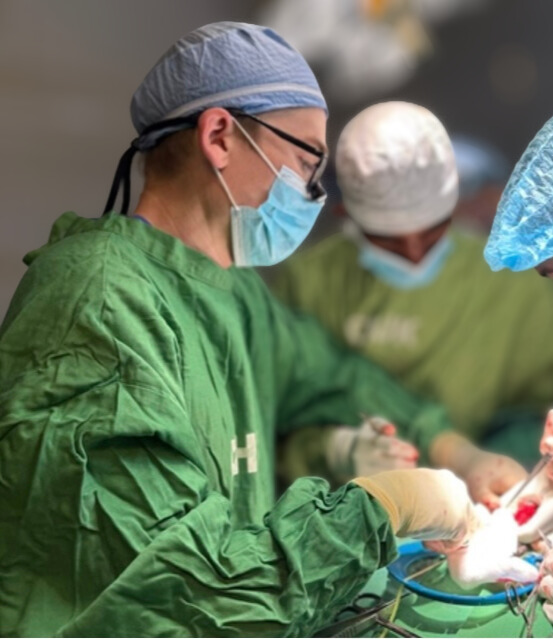
As Dr. Ivan operates, his Kigali peers look on
“During Fellowship training, I wanted to stretch my skills and perspective, so with the support and encouragement of Dr. Simhan, I applied to an international urologic teaching mission in Kigali, Rwanda, sponsored by the Society of Genitourinary Reconstructive Surgeons (GURS) and International Volunteers in Urology (IVUmed). These organizations are providing expert education and subspecialty training to surgeons in remote locales with the goal of bringing advanced reconstructive urologic surgical care to the people who live there,” said Ivan.
Ivan was honored with a travel scholarship from the GURS and the chance to participate in this education/training mission—just one of two surgeons chosen from all reconstructive urologic fellowship programs in the US.
In May of 2025, Ivan and his US cohort headed to The University Teaching Hospital of Kigali, the only urology training site in Rwanda. “The Rwandan urologic surgeons were technically excellent, but opportunities for reconstructive urologic surgical training didn’t exist. This outreach program seeks to fill this gap with training missions spread over five years, with the goal to create a self-sustaining reconstructive urology program in Kigali.”
Arriving in Kigali on a Saturday, Ivan and the team marveled at how clean and modern the city seemed. However, the “major” hospital where they were working was from another era: OR doors hanging off hinges, faltering air conditioning, and gowns that were re-sterilized and reused.
“We take so much for granted,” said Ivan. “Knowing that surgical equipment would be lacking, we brought catheters, disposable surgical gowns and gloves, and select instruments for our Kigali peers. The hospital only had one working cystoscope, whereas here we might have ten.
“On our first day there, we held a clinic with the Rwandan surgeons and saw upward of forty patients. We discussed the appropriate surgical approach for each patient and ensured each case had the personnel and equipment to perform it safely and successfully.
“We built out the surgery schedule for the week. On Monday, we went full speed ahead in the OR for five days. For each case, there was a Rwandan attending and trainee surgeon, and the same type of clinical personnel from the US. Working together, training and connecting across continents made the world seem very small and was immensely satisfying.
“On our last evening in Kigali, a pharmaceutical company brought dinner for everyone participating in the program from Rwanda and the US. There we were—a bunch of doctors sitting at a long table—enjoying a meal and each other’s company. It felt like home, and in a way, it was. Since surgeons are surgeons no matter where they are in the world.”